Search

 한국어
 русский
 عربى
Weight per Meter: The Formula, the Constant and Where It Comes From
Weight per meter in kilograms is (OD - wall thickness) x wall thickness x 0.02491. Outer diameter and wall thickness are entered in millimetres, the result comes back as kilograms per meter, and 0.02491 is the density constant for grade 304 stainless steel.
Metric, round tube: kg/m = (OD - t) x t x C
C = 0.02491 for 304/304L, 0.02513 for 316/316L, 0.02450 for 2205 and 2507 duplex, 0.02434 for 409/410/444, 0.02765 for Monel 400.
Total weight: kg per piece = kg/m x length in meters. Total order weight = kg per piece x number of pieces.
The constant is not a trade secret, it is just geometry and density pressed into one number. A tube wall is an annulus, so its cross-sectional area in square millimetres equals pi x (OD - t) x t. One meter of that section is 1000 mm long, which gives a volume in cubic millimetres, and dividing by 1000 converts it to cubic centimetres. Multiply cubic centimetres by density in grams per cubic centimetre and you have grams, then divide by 1000 for kilograms.
That whole chain collapses into pi divided by 1000, multiplied by density. For 304 the nominal density is 7.93 g/cm3, so 0.0031416 x 7.93 = 0.02491. For 316L the nominal density is 8.00 g/cm3, giving 0.02513. Nothing else in the formula changes when the grade changes, which is why buyers who memorize one constant and one number rarely get into trouble.
The practical consequence is that the grade choice is a weight decision as much as a corrosion decision. Running the same 60.3 mm OD, 2.77 mm wall tube in 304, 316L and 2205 produces three different masses per meter, and across a 20 tonne order that difference lands directly on the freight invoice and on the lifting plan.
| Grade family | Typical density (g/cm3) | Constant C |
|---|---|---|
| 304 / 304L / 304H | 7.93 | 0.02491 |
| 316 / 316L / 316Ti | 8.00 | 0.02513 |
| 321 / 321H | 7.90 | 0.02482 |
| 310S | 7.98 | 0.02507 |
| 347 / 347H | 8.00 | 0.02513 |
| 904L (N08904) | 8.00 | 0.02513 |
| S31254 super austenitic | 8.00 | 0.02513 |
| S31803 / S32205 duplex | 7.80 | 0.02450 |
| S32750 super duplex | 7.80 | 0.02450 |
| S32304 lean duplex | 7.75 | 0.02434 |
| 409 / 430 / 439 ferritic | 7.70 | 0.02419 |
| 444 ferritic | 7.75 | 0.02434 |
| 410 martensitic | 7.75 | 0.02434 |
| Monel 400 | 8.80 | 0.02765 |
| Incoloy 800 / 800H | 7.94 | 0.02494 |
| Inconel 625 | 8.44 | 0.02652 |
Two rows in that table are worth memorizing. Duplex is roughly 1.7 percent lighter than 316L at identical dimensions because its density is lower, and Monel 400 is about 10 percent heavier than 304. A quotation built on the 304 constant for a nickel alloy order will understate the shipping weight by several hundred kilograms on a container load.
Why the Density Value Matters More Than the Arithmetic
The arithmetic never goes wrong, the input does. The most common mistake in weight calculations is treating 7.93 as a universal stainless density, and the second most common is using a carbon steel constant of 0.02466 on a stainless order.
Nominal density is published, but the real figure moves within a narrow band from heat to heat. Chromium and nickel content shift the density slightly, and cold work reduces it a fraction. For commercial purposes the nominal figure is the right one to quote, because purchase orders, mill certificates and packing lists are all built on nominal density. What you should not do is claim a weighbridge tolerance tighter than the real process can hold.
Consider the spread on a 3 tonne order of 25.4 mm OD, 2.11 mm wall tube. At the 304 constant the calculated weight is 1.224 kg/m. At the 316L constant it is 1.235 kg/m. On 2450 meters of tube that is a 27 kg gap, small enough to absorb, but a 10 percent wall tolerance on the same order can move the actual mass by 250 kg or more. Grade density is a rounding issue; wall tolerance is the real one.
Where density genuinely changes a commercial decision is on nickel alloys and super austenitics. A 904L heat exchanger bundle and a 316L bundle of identical tube count are about the same weight, but a Monel 400 bundle is not, and neither is an Inconel 625 bundle at 8.44 g/cm3. Tube support spacing, bundle weight per channel and crane capacity all need the correct constant before the drawing is released.
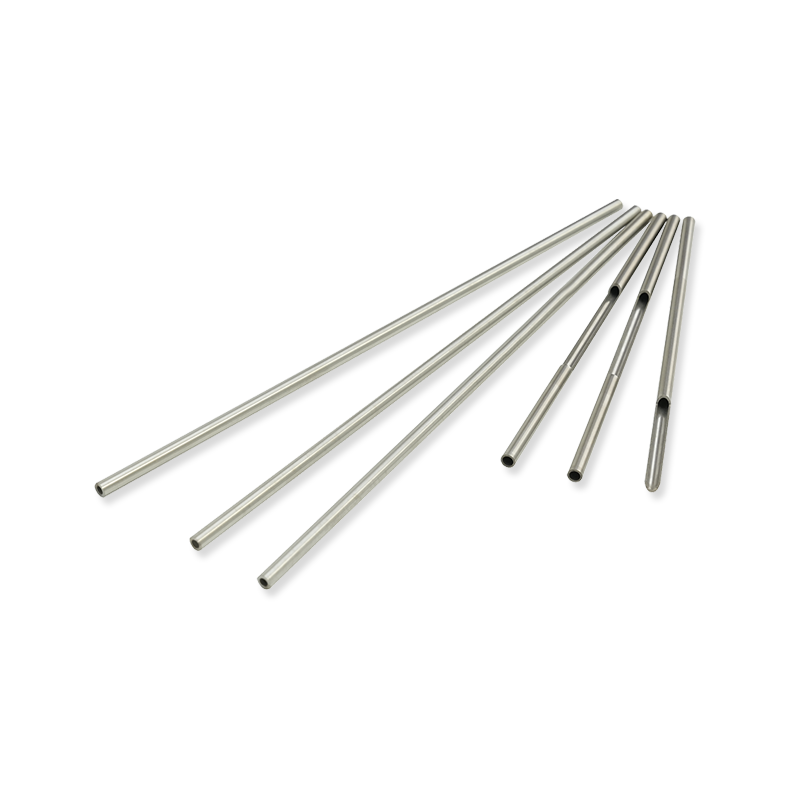 TP316/316L/316H/316Ti Austenitic Stainless Steel PipeMolybdenum-bearing seamless pipe in four 316 grade variants, relevant here for checking tube weight and bundle loads before release.View Product →
Four Worked Examples You Can Copy Directly
Example 1: instrument tubing, 25.4 mm OD, 2.11 mm wall, TP316L, 6 meter lengths
Subtract the wall from the OD: 25.4 - 2.11 = 23.29. Multiply by the wall: 23.29 x 2.11 = 49.14. Multiply by the 316L constant: 49.14 x 0.02513 = 1.235 kg/m. One 6 meter length is 7.41 kg. An order of 400 lengths is 2964 kg, or 2.964 tonnes, before packaging.
Example 2: process pipe, 114.3 mm OD, 6.02 mm wall, TP304, 12 meter lengths
114.3 - 6.02 = 108.28. Multiply by 6.02 = 651.85. Multiply by 0.02491 = 16.24 kg/m. One 12 meter length is 194.9 kg. A 40 piece order is 7796 kg, which is why this size is normally handled with a crane rather than a forklift and never bundled beyond the lifting limit.
Example 3: square and rectangular tube
Round formula does not apply. For rectangular hollow section the cross-sectional area is 2t x (h + w - 2t), where h and w are the outside dimensions in millimetres. With density folded in, the 304 version becomes kg/m = 0.01586 x t x (h + w - 2t).
A 40 x 40 x 2 mm square tube in 304: 0.01586 x 2 x (40 + 40 - 4) = 0.01586 x 152 = 2.41 kg/m. A 40 x 20 x 1.5 mm rectangle in 316L: 0.01591 x 1.5 x (40 + 20 - 3) = 0.01591 x 85.5 = 1.36 kg/m. The 0.01591 figure is simply 2 x 8.00 / 1000 for 316L.
Example 4: converting kilograms back into meters
Meters available per tonne = 1000 divided by kg/m. For 16.24 kg/m that is 61.6 meters per tonne. If the client asks for 5 tonnes of the same size, the answer is 308 meters, or 25 full 12 meter lengths plus 8 meters of remnant, which is usually not what they want to receive. Always round down to a whole number of standard lengths and quote the resulting tonnage rather than the requested tonnage.
Per meter
(OD - t) x t x C, dimensions in mm.
Per piece
kg/m x length in meters, then rounded to two decimals for the packing list.
Per tonne
1000 divided by kg/m gives meters per tonne, the fastest sanity check on any quotation.
Reference Table: Weight per Meter for Common Round Sizes
The table below is calculated with the 304 constant of 0.02491 and the 316L constant of 0.02513. Dimensions follow common ASTM and EN ordering sizes. Use it for a first estimate, then recalculate with the exact wall called out on the purchase order, because a 0.2 mm wall difference on small tube is a 5 percent weight difference.
| OD (mm) | Wall (mm) | kg/m, 304 | kg/m, 316L | kg per 6 m length, 304 |
|---|---|---|---|---|
| 6.35 | 0.89 | 0.121 | 0.122 | 0.73 |
| 9.53 | 1.24 | 0.256 | 0.258 | 1.54 |
| 12.70 | 1.24 | 0.354 | 0.357 | 2.12 |
| 19.05 | 1.65 | 0.715 | 0.721 | 4.29 |
| 25.40 | 1.65 | 0.976 | 0.985 | 5.86 |
| 25.40 | 2.11 | 1.224 | 1.235 | 7.34 |
| 31.80 | 1.65 | 1.239 | 1.250 | 7.43 |
| 38.10 | 1.65 | 1.498 | 1.511 | 8.99 |
| 50.80 | 2.77 | 3.314 | 3.343 | 19.88 |
| 60.30 | 2.77 | 3.970 | 4.005 | 23.82 |
| 76.20 | 3.05 | 5.558 | 5.607 | 33.35 |
| 88.90 | 3.05 | 6.522 | 6.580 | 39.13 |
| 101.60 | 3.05 | 7.487 | 7.553 | 44.92 |
| 114.30 | 6.02 | 16.240 | 16.383 | 97.44 |
| 168.30 | 3.40 | 13.970 | 14.092 | 83.82 |
| 219.10 | 4.78 | 25.520 | 25.745 | 153.12 |
| 273.00 | 6.35 | 42.180 | 42.552 | 253.08 |
| 323.90 | 6.35 | 50.230 | 50.673 | 301.38 |
| 355.60 | 8.00 | 69.270 | 69.881 | 415.62 |
| 406.40 | 8.00 | 79.390 | 80.090 | 476.34 |
Read across the table and the scaling becomes obvious. Doubling the OD at constant wall roughly doubles the mass per meter, while doubling the wall at constant OD more than doubles it, because weight scales with wall thickness multiplied by the mean diameter. On large OD tube the wall dominates the number, and on small OD tube the OD dominates it.
Theoretical Weight, Actual Weight and the Tolerance Gap
Calculated weight is a theoretical figure based on nominal dimensions and nominal density. Weighed weight is what the scale at the port says. The gap between the two is normal, and it is governed by the tolerances written into the purchase order, not by the formula.
Wall thickness is the biggest single contributor. Most stainless tube orders are placed against a wall tolerance band in the range of plus or minus 10 to 12.5 percent, with the exact figure depending on the standard and the tolerance class specified. A tube ordered at 2.11 mm can therefore leave the mill at 2.32 mm and still conform.
Run the numbers again at that upper wall: 25.4 - 2.32 = 23.08, multiplied by 2.32 = 53.55, multiplied by 0.02513 = 1.346 kg/m against a nominal 1.235 kg/m. That is a 9 percent increase on paper, and it is entirely legitimate product.
On thin-wall tube the weight change is close to linear with wall change, so a 10 percent wall increase produces roughly a 9 to 10 percent weight increase. On heavy wall tube the relationship softens, because the mean diameter shrinks as the wall grows. This is why heavy wall sizes should always be recalculated rather than scaled.
Length tolerance adds a second, smaller layer. Cut lengths are usually supplied to a positive tolerance, and a millimeter or two per piece across 3000 pieces is measurable. Ovality, end squareness and the bevel or plain end condition all change the mass slightly.
Then there is the honest operational gap: oil, dust, moisture and packaging. Bundled tube with steel straps, plastic caps and wooden skids routinely weighs 1 to 3 percent more than the tube alone. On a 20 tonne shipment that is up to 600 kg of packaging, and it counts against container payload even though nobody wants to pay freight on wood.
The right way to handle all of this is to quote theoretical weight for the commercial documents, state the applicable tolerance class clearly, and allow a working margin of 2 to 4 percent when booking freight. Buyers who treat the calculated number as a promise will spend their week arguing with a weighbridge ticket that is completely correct.
heavy wall stainless steel pipesReverse Calculations: Meters per Tonne, Pieces per Bundle, Coils per Skid
Most real questions run backwards. The customer knows the tonnage, or the crane limit, or the container payload, and needs to know how many meters that represents.
Meters per tonne = 1000 / kg per meter. Pieces per bundle = bundle weight limit / (kg per meter x length). Piece weight = kg per meter x length. These three lines answer almost every logistics question that arrives with a tube enquiry.
Worked case: a customer needs exactly 1000 kg of 114.3 x 6.02 mm TP304. At 16.24 kg/m that is 61.6 meters. In 12 meter lengths that is 5 pieces plus a 1.6 meter remnant, so the practical answer is 5 pieces at 974 kg, or 6 pieces at 1169 kg. Both are correct, and the choice depends on whether the customer prefers to be short or to carry extra stock.
Coil stock
For coiled tube, weight per meter is the same formula, and coil weight equals kg/m x total coil length. A 500 kg coil of 9.53 x 1.24 mm runs to roughly 1950 meters, which is a useful number when planning a run of small-diameter tube.
U-tubes
For U-shaped tube, compute the developed length first, then multiply by kg/m. Two straight legs plus the bend allowance is close enough for commercial purposes; the bend radius leg difference is normally under one percent of total mass.
Bundles
A bundle is limited by crane capacity, not by weight alone. A 3 tonne bundle of 25 mm tube is physically large and awkward; a 3 tonne bundle of 114 mm tube is a short, dense stack. Plan the bundle around the handling equipment.
Where coil and precision tube are involved, the weight figure feeds directly into shipping documentation and into the customer's own machine loading plan. It pays to publish both kg/m and meters per coil on the packing list rather than leaving the buyer to reverse the numbers.
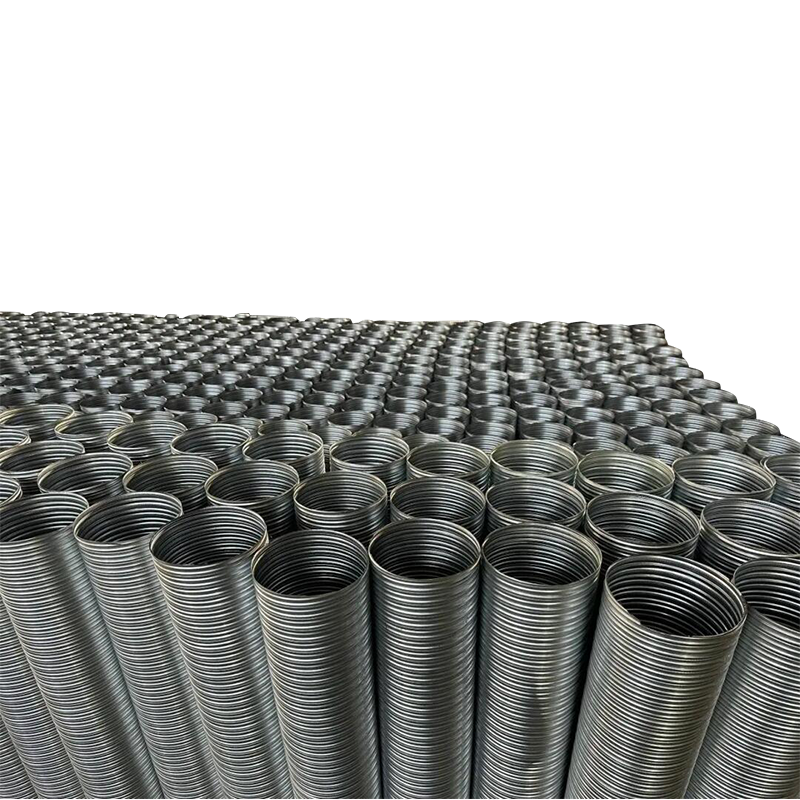 Stainless Steel Coil Pipe and Bright Coil TubeBright, smooth-surfaced coil tube used in pharmaceutical, food and heat-exchanger service; coil weight and length data support shipping plans.View Product →
Freight and Container Payload: Where a Rounding Error Gets Expensive
Freight is priced on either weight or volume, whichever is greater, and stainless tube sits awkwardly between the two. A container full of small diameter tube will cube out before it weighs out. A container full of heavy wall pipe will weigh out long before it cubes out. Knowing which one you are dealing with decides whether you ship 18 tonnes or 26 tonnes.
For less than container load shipments, the chargeable weight is typically the greater of the actual weight in tonnes and the volume in cubic meters, so the conversion factor is effectively 1000 kg per cubic meter. Small diameter tube in long bundles is bulky; check the volumetric figure before assuming the weight will govern.
For full container loads, a 20 foot general purpose container is rated around 28 tonnes of payload on paper, but road legal limits in Europe and North America usually cap a loaded container closer to 24 to 25 tonnes. A 40 foot container offers more volume but not proportionally more payload, which is why dense pipe cargo often travels in 20 foot boxes.
Worked case: 219.1 x 4.78 mm TP304 at 25.52 kg/m. A 24 tonne payload allows 940 meters. In 6 meter lengths that is 156 pieces, and the stack of 156 pieces at 219 mm OD occupies far less than a full 20 foot container, so this cargo weighs out. The same container filled by volume with 12.7 mm tube would carry far less than 24 tonnes, and the freight cost per tonne would triple.
The chart above shows the same 60.3 mm OD tube in five wall thicknesses, all calculated with the 304 constant. Going from 1.65 mm to 5.54 mm more than triples the mass per meter, and the payload limit arrives three times sooner. That is the single most useful weight comparison when a project engineer asks whether a heavier wall is affordable.
Length also changes the freight calculation in ways that are easy to overlook. Long lengths travel badly in standard containers, and beyond about 12 meters the tube must move on break bulk or flat rack equipment, which changes both the rate and the loading plan. Where a project genuinely needs long runs with fewer field welds, the weight per piece must be checked against the lifting equipment on site as well as the vessel.
extra long stainless steel tubingSix Places Where the Calculated Weight Drifts on a Real Order
These are the items that most often explain a difference between the calculated figure and the shipped figure. None of them are errors in the formula; all of them are normal variables that should be quantified before the order ships.
1. Wall tolerance
Plus or minus 10 to 12.5 percent on wall is standard on many stainless tube specifications. It is the largest single source of weight variation and the one worth agreeing explicitly at quotation stage.
2. Length and cut allowance
Cut lengths are normally supplied to a positive tolerance. A 2 mm allowance on a 6 meter length is 0.03 percent, but on 5000 pieces it adds up to a few hundred kilograms.
3. Real versus nominal density
Heat chemistry moves density by a fraction of a percent. This matters for reporting, not for commercial settlement, but it should be understood before anyone claims the mill shipped the wrong weight.
4. End finish
Beveled ends, threaded ends, caps and plugs all add mass that never appears in a per meter calculation. Threaded and coupled tube can add 1 to 2 percent on small sizes.
5. Packaging
Steel strapping, wooden skids, plastic end caps and VCI wrapping routinely add 1 to 3 percent to the gross weight on the bill of lading.
6. Weighbridge conditions
Water, dust and oil on the surface can add measurable mass after a long sea leg. Weigh after drying where the figure is commercially important.
There is a simple discipline that removes most disputes. State the calculation method, the density constant used and the tolerance class in the quotation. Then show theoretical weight and estimated gross weight as two separate columns on the packing list. Buyers stop arguing when both numbers are visible and both are labelled.
Using Weight Data to Choose a Lighter, Stronger Tube
Weight per meter is not only a logistics number. It is a design number, and one of the most useful comparisons in stainless tube selection is between an austenitic grade and a duplex grade at the same pressure duty.
Duplex S32205 carries a minimum yield strength roughly two and a half times that of 316L, and duplex is also slightly less dense. The combination means a duplex tube can often be specified with a thinner wall for the same design pressure, and the resulting tube is meaningfully lighter per meter than the 316L alternative. Two effects pull in the same direction: thinner wall and lower density.
A practical illustration: a 60.3 mm OD line designed around 316L at 3.91 mm wall, at 5.49 kg/m, can in some pressure classes be served by a duplex tube at a thinner wall, and the mass per meter drops well below 5 kg/m. On a long offshore run with hundreds of meters of tube, that difference changes the support spacing, the bundle weights and the installation plan.
The weight saving is real, but it is not free. Duplex needs qualified welding procedures, tighter heat input control and a proper post-weld cleaning regime. The correct way to use weight data is as a screening tool: calculate both options, compare the installed mass and the welding cost, then decide. Weight alone rarely wins the argument, but it frequently starts a useful one.
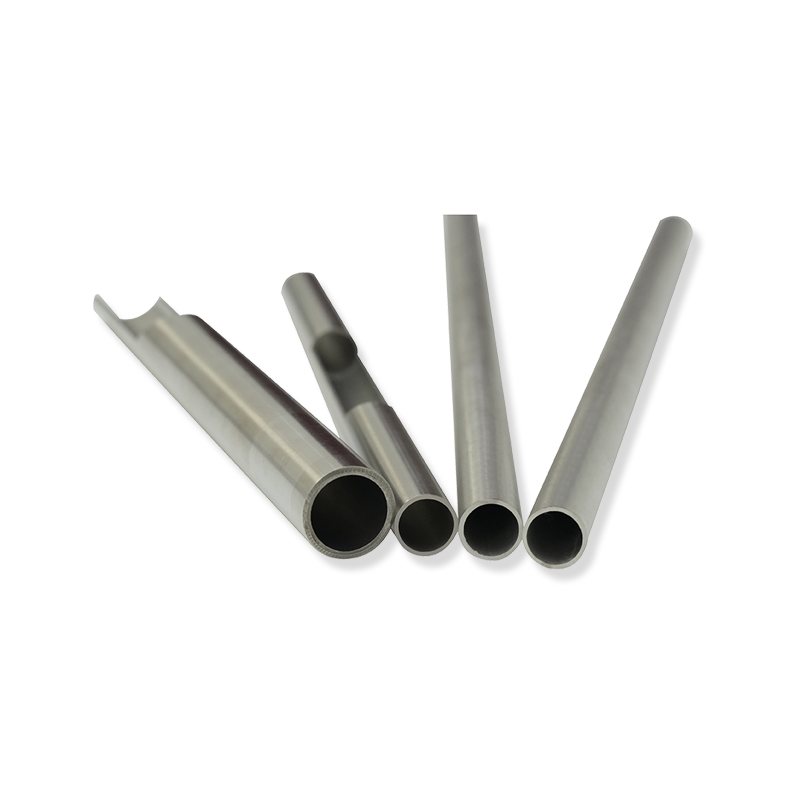 S2205 Duplex Stainless Steel Seamless PipeDuplex 2205 seamless pipe for oil, gas, chemical and marine service, useful when comparing corrosion-resistant, high-strength pipe options and installed weight.View Product →
Imperial Units, Conversions and Rounding Rules
Not every buyer works in millimetres and kilograms, and mixing unit systems is a reliable way to produce a wrong quote. The two systems convert cleanly once the constants are right.
In imperial units the round tube formula is lb/ft = 10.80 x (OD - t) x t, with dimensions in inches. The constant 10.80 corresponds to the 304 density; for 316L it is 10.90, and for duplex it is 10.63. The reason the constant looks large is that it folds in pi, twelve inches per foot and density in pounds per cubic inch.
Conversions worth keeping at hand: 1 kg/m equals 0.6720 lb/ft, 1 lb/ft equals 1.4882 kg/m, 1 inch equals 25.4 mm, and 1 short ton equals 907.2 kg. A 20 foot length is 6.096 meters, and a 40 foot length is 12.192 meters.
Rounding should follow the document. Quotations and order confirmations usually round to three decimals on kg/m and to whole kilograms on total weight. Packing lists often round per piece to two decimals, which can introduce a small cumulative error across a large piece count; add the pieces first, then round the total.
One more convention matters. Theoretical weight is the basis for most international stainless tube trade, and it is stated as such on the mill certificate. Where a contract specifies actual weighed weight, the tolerance band and the weighing method should be written into the agreement, otherwise the two parties are measuring different things.
A Pre-Order Checklist for Weight-Critical Orders
- Confirm the exact OD and wall on the purchase order, not the nearest catalogue size.
- Select the correct density constant for the grade actually being supplied, not the grade in the enquiry.
- Decide whether the contract is on theoretical or actual weight, and write it down.
- Agree the wall tolerance class, then calculate the weight at both the upper and lower limits.
- Convert the tonnage into whole lengths and check the remainder is acceptable.
- Add packaging allowance of 1 to 3 percent for the gross weight on shipping documents.
- Check piece weight against the crane or forklift available at both the loading port and the destination site.
- Recalculate the container plan against the payload limit, not the volume limit, for dense cargo.
Each of these steps takes minutes and prevents the two failure modes that cost the most: a container that is legally overloaded on the road, and a customer who expected 20 tonnes and received 20.6 tonnes with a completely valid certificate.
Frequently Asked Questions
What is the formula for stainless steel tube weight per meter?
(OD - wall thickness) x wall thickness x 0.02491 for grade 304, with dimensions in millimetres and the result in kilograms per meter. Substitute 0.02513 for 316L, 0.02450 for duplex or 0.02765 for Monel 400.
Why is the constant different from carbon steel?
Because density is different. Carbon steel uses 0.02466 based on 7.85 g/cm3, while 304 stainless uses 0.02491 based on 7.93 g/cm3. Using the carbon constant on a stainless order understates the weight by about one percent.
How accurate is a calculated weight?
It is exact for nominal dimensions and nominal density. Against a physical shipment, expect a difference of 1 to 4 percent from wall tolerance, length allowance and packaging, and quote with that margin in mind.
How do I convert kilograms per meter into meters per tonne?
Divide 1000 by the kg/m figure. At 16.24 kg/m, one tonne is 61.6 meters. This is the fastest way to check whether a requested tonnage converts into a sensible number of standard lengths.
Does the formula work for square and rectangular tube?
No, use kg/m = 2t x (h + w - 2t) x density / 1000 instead. For 304 that simplifies to 0.01586 x t x (h + w - 2t) with all dimensions in millimetres.
Should I quote theoretical or actual weight?
Theoretical weight is the international norm for stainless tube and is what appears on most mill certificates. If the contract requires actual weighed weight, specify the weighing method and tolerance band in writing.
How much does packaging add to the shipping weight?
Typically 1 to 3 percent for strapping, skids, caps and wrapping. On heavy wall pipe the percentage is lower; on thin wall small diameter tube in long bundles it can be higher.
Can I reduce tube weight without changing the outside diameter?
Yes, in two ways: specify a thinner wall where the design pressure allows, or move to a higher strength duplex grade that permits a thinner wall for the same duty. Both change the mass per meter, and both change the welding and handling requirements.