Search
 한국어
한국어 русский
 عربى
عربى
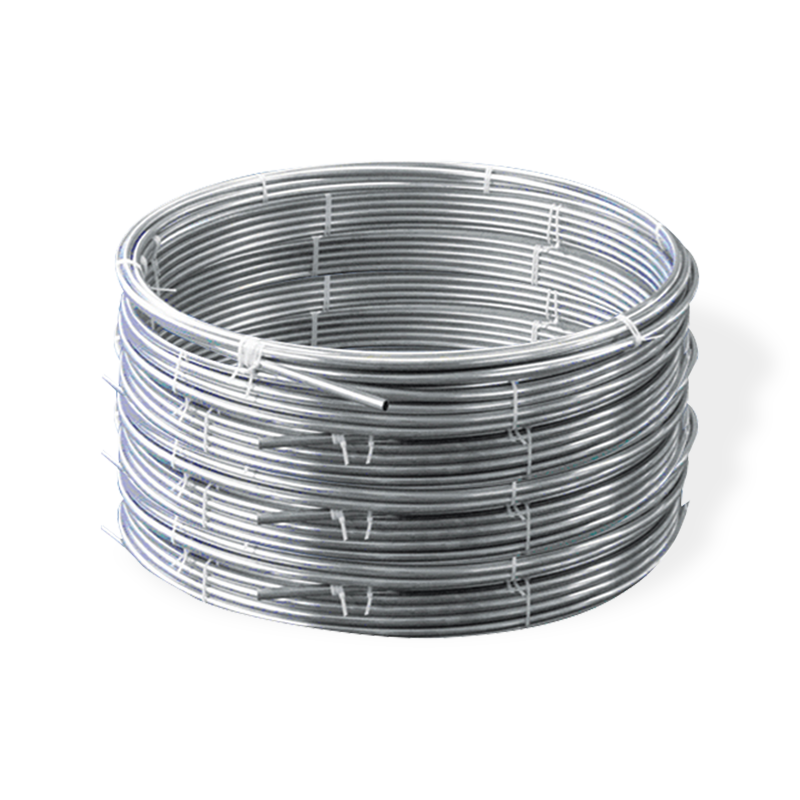
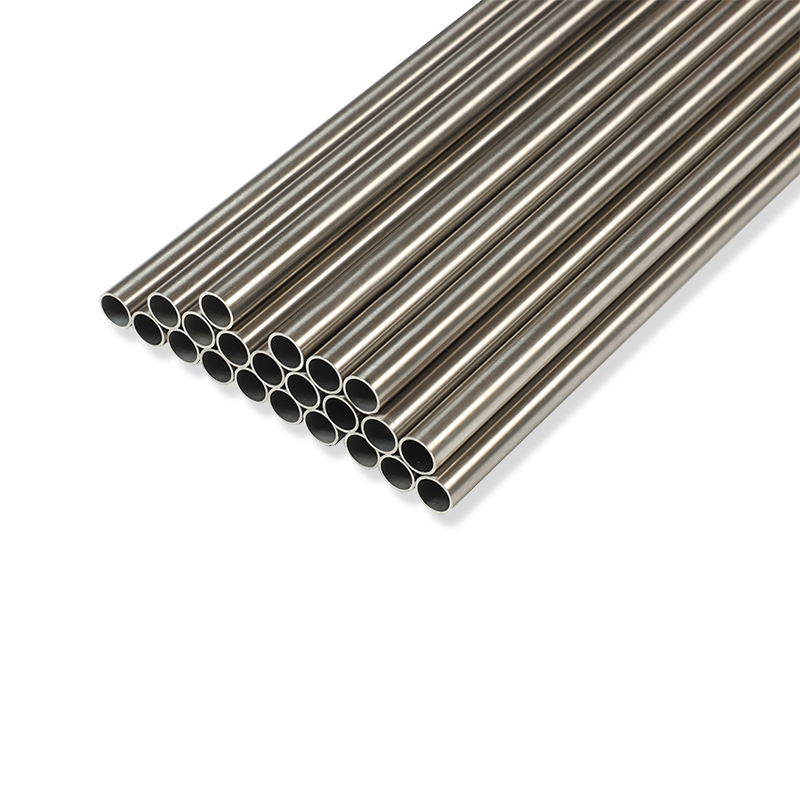
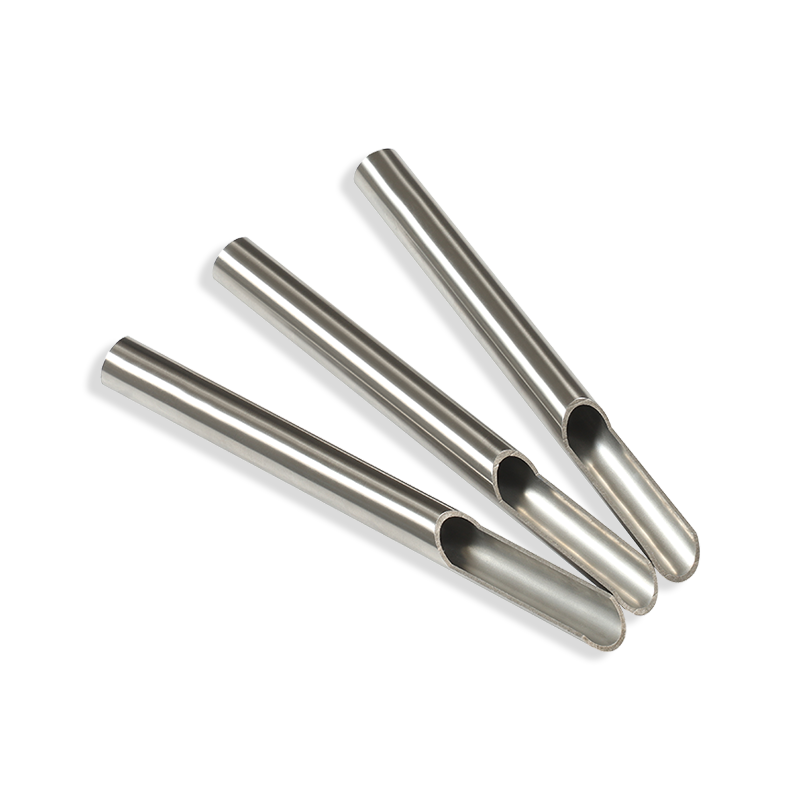
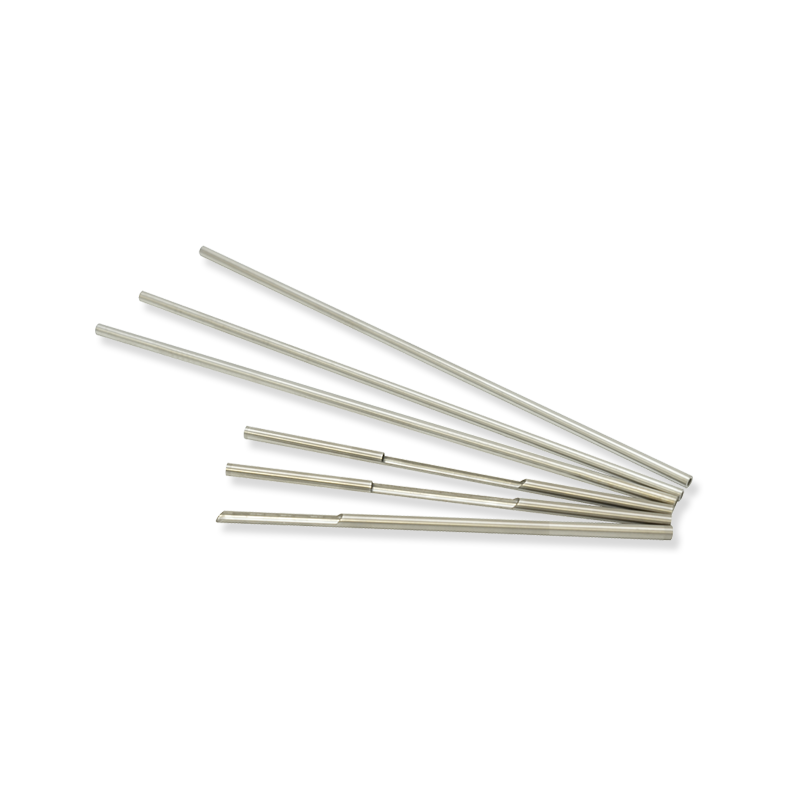
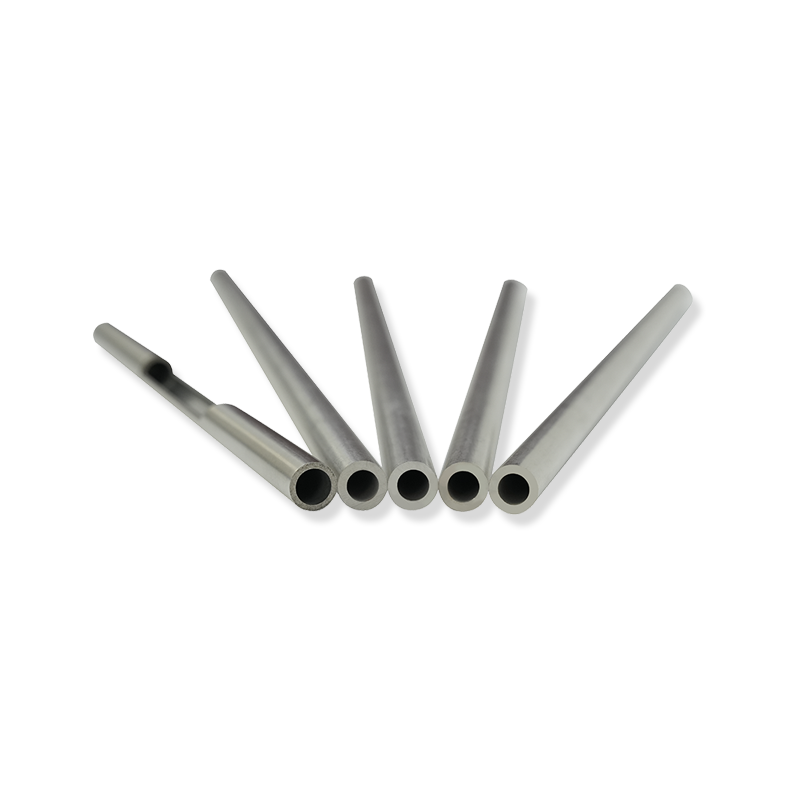
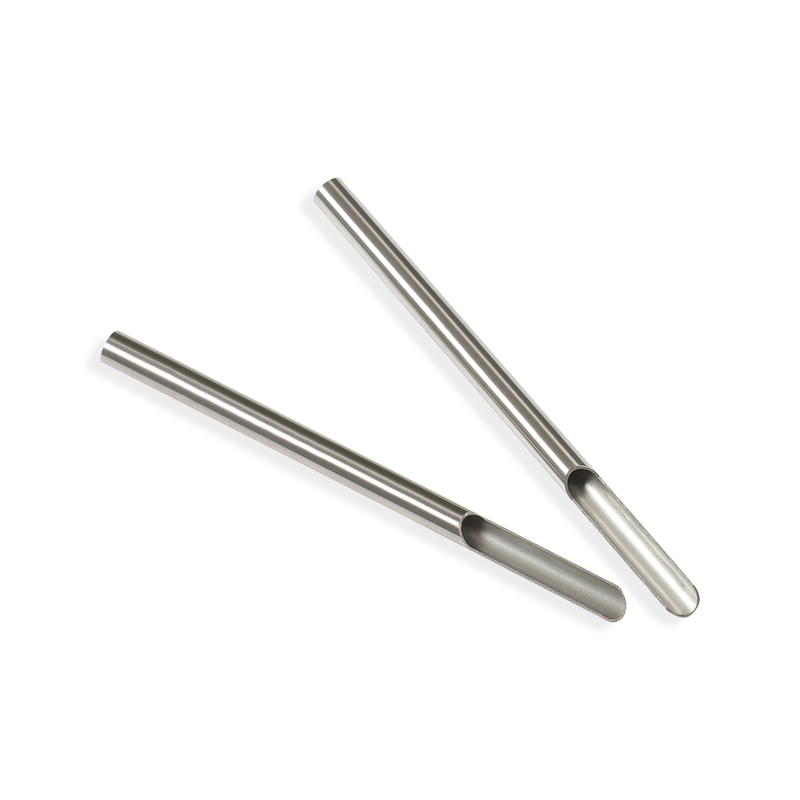
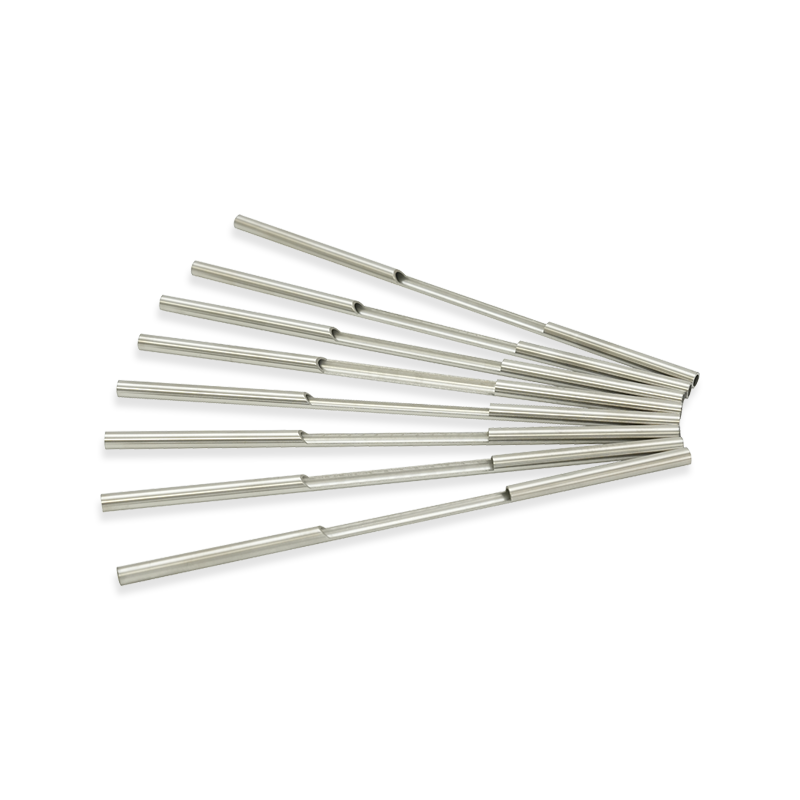
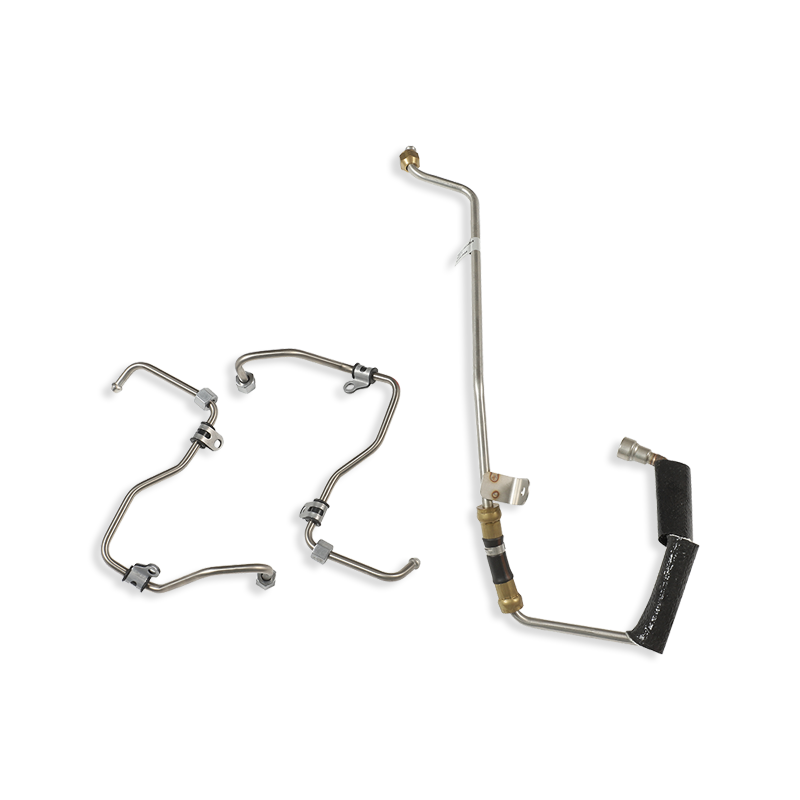
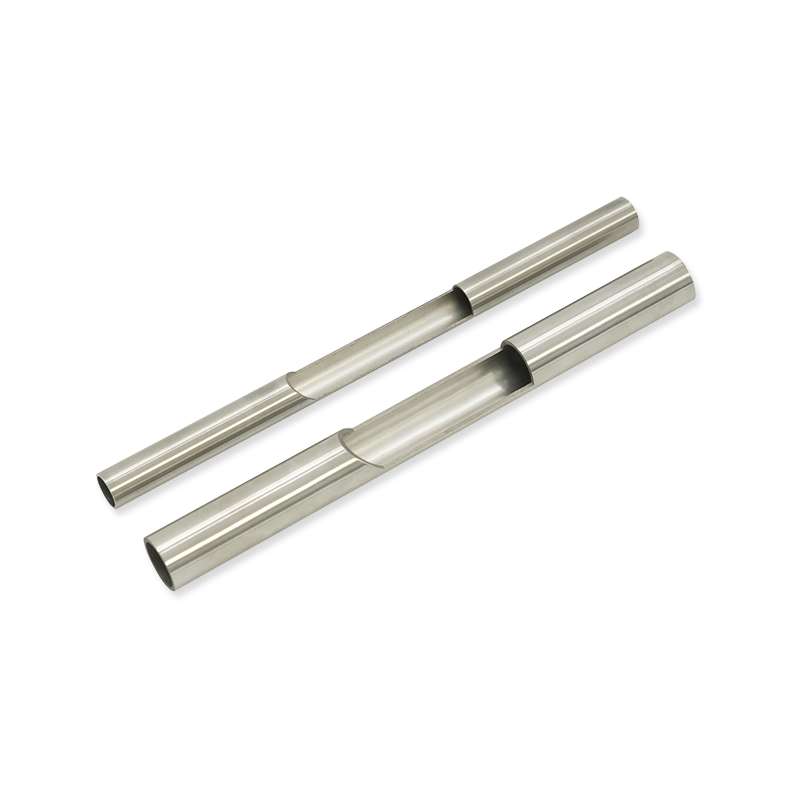
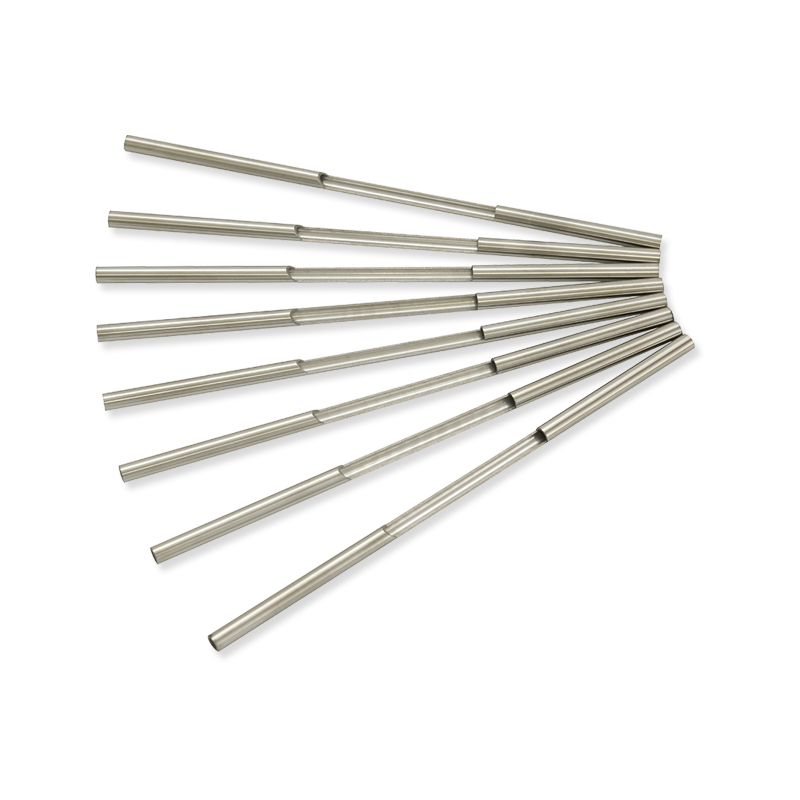
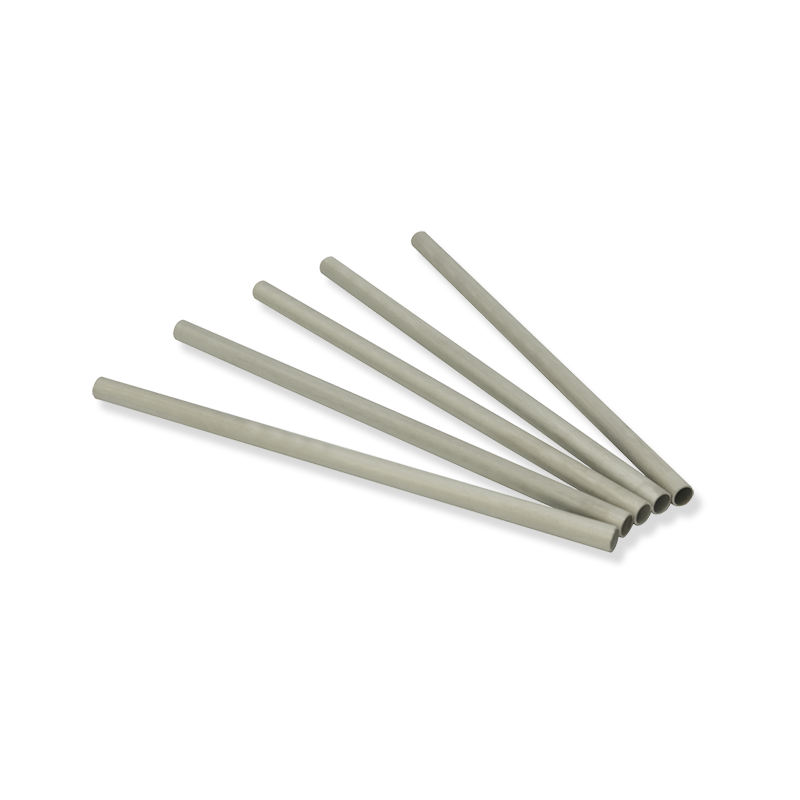

Utilizing 26 high-precision cold rolling mills and 6 cold drawing machines, we ensure dimensional accuracy and superior mechanical properties.
Automotive Exhaust Stainless Steel Tubing
ASTM A268 | TP409 / TP439 / TP441 / TP444 | Ferritic Grades | IATF 16949 Certified
ISO 9001 | IATF 16949 | PPAP AvailableRelated Products
Introduction
The automotive exhaust system represents one of the most mechanically and thermally demanding environments to which any metallic structural component can be subjected in continuous cyclic service — encompassing rapid temperature excursions from ambient cold-start conditions to exhaust gas temperatures exceeding 900°C in catalytic converter-adjacent sections, corrosive attack from condensed water containing sulfuric and hydrochloric acid during the cold-start warm-up phase before the system reaches operating temperature, high-frequency vibration transmitted from the engine through the exhaust manifold and flex coupler, and the cumulative fatigue damage from the millions of thermal expansion-contraction cycles accumulated over a vehicle's operating life of 200,000 to 300,000 kilometers. Automotive Exhaust Stainless Steel Tubing is the established engineering material solution for these combined demands — replacing the mild steel aluminized and stainless-clad exhaust systems of the previous generation with solid stainless steel tube systems that deliver the oxidation resistance, corrosion protection, thermal fatigue resistance, and dimensional stability required to meet the extended exhaust system warranty periods — now reaching 10 years or 200,000 kilometers in premium vehicle programs — that automotive OEMs demand as a competitive differentiator and customer satisfaction driver in the global passenger car and commercial vehicle market. The selection of the specific stainless grade for each section of the exhaust system is a carefully engineered compromise between temperature resistance, corrosion protection, formability, weldability, and cost, with the ferritic stainless grades — particularly TP409, TP439, TP441, and the higher-performance TP444 — dominating the market for their unique combination of adequate high-temperature strength, excellent resistance to cyclic oxidation, and significantly lower cost than the austenitic grades that are reserved for the most thermally extreme exhaust positions immediately adjacent to the engine manifold and turbocharger outlet.
The engineering selection of stainless grade for specific exhaust system positions follows a well-established temperature-corrosion resistance hierarchy that has been refined through decades of automotive exhaust system development and extensive field durability testing under real-world driving conditions. At the exhaust manifold — the first component in the exhaust gas path, operating at the highest temperatures of 750–1000°C in gasoline engine applications and 600–800°C in diesel applications — austenitic grades such as TP321 and TP347 or cast austenitic alloys are typically specified for their superior creep resistance and oxidation protection at these extreme temperatures. In the section from the manifold to the catalytic converter — where temperatures range from 600°C to 800°C — titanium-stabilized TP409 provides adequate oxidation resistance at significantly lower cost than austenitic alternatives, making it the standard specification for this section in cost-sensitive passenger car programs. From the catalytic converter back through the center section to the rear silencer, where temperatures have moderated to 300–600°C but road salt splash corrosion, condensate acid attack, and vibration fatigue become the dominant life-limiting mechanisms, titanium-niobium dual-stabilized TP439 and TP441 provide superior corrosion resistance compared to TP409 while maintaining the excellent formability and weldability that high-volume automotive exhaust tube stamping, bending, and welding operations demand.
The manufacturing requirements for automotive exhaust stainless steel tubing are shaped by the high-volume, low-unit-cost economics of automotive component production, which demand tube dimensional consistency tighter than standard industrial tube tolerances, surface quality adequate for laser welding and high-frequency welding of thin-wall sections, and mechanical property uniformity across production lots sufficient to maintain consistent forming behavior in automated exhaust system fabrication lines. Wall thicknesses for automotive exhaust tube are typically thin — 1.0mm to 2.0mm in standard passenger car applications, 2.0mm to 3.0mm in heavy commercial vehicle applications — requiring production processes with precise thickness control to avoid the formability problems that arise from wall thickness variation in thin-wall stainless tube bending and hydroforming operations. The tube surface must be free from pits, laps, and scale that would initiate corrosion at the surface defect site during the condensate acid exposure phase of cold-start operation, making surface quality inspection a critical quality gate in automotive exhaust tube production. Our automotive exhaust tubing is produced to IATF 16949 automotive quality management system requirements, with statistical process control records, dimensional capability studies, and PPAP documentation available to support automotive Tier 1 and Tier 2 supplier qualification programs that require evidence of manufacturing process capability as well as product quality conformance.
Our automotive exhaust stainless steel tubing program covers the complete grade portfolio required for full exhaust system specification from manifold to tailpipe — TP409 (UNS S40900), TP439 (UNS S43035), TP441 (UNS S44100), and TP444 (UNS S44400) — in outside diameters from 25.4mm to 152.4mm with wall thicknesses from 1.0mm to 3.5mm. All grades are supplied in the annealed condition with controlled grain size optimized for forming, and weldability is verified by production weld qualification per ISO 15614 and relevant automotive welding standards. Dimensional tolerances meet the tight requirements of automotive tube fabrication lines, with OD tolerance of ±0.10mm and wall thickness tolerance of ±0.10mm standard across the program. PPAP documentation, IATF 16949 certificates, material test reports with actual chemistry and mechanical properties, and automotive supplier qualification support are available for Tier 1 and Tier 2 exhaust system component suppliers.
Specifications
| Available Grades | TP409, TP439, TP441, TP444 (Ferritic) |
| Standard | ASTM A268, EN 10216-5, IATF 16949 |
| Outer Diameter | 25.4mm - 152.4mm |
| Wall Thickness | 1.0mm - 3.5mm |
| OD Tolerance | ±0.10mm (Automotive Grade) |
| Finish | Annealed, Controlled Grain Size |
Chemical Composition (TP409)
| Element | C | Cr | Ni | Ti | Mn | Si | N |
| Value (%) | ≤0.08 | 10.5-11.75 | ≤0.50 | 6×(C+N) min | ≤1.00 | ≤1.00 | ≤0.04 |
Exhaust Grade PortfolioIATF 16949PPAP Ready
Mechanical Strength (TP409)
Comprehensive Info
| MOQ | 500kg per grade (Automotive volumes) |
| Lead Time | 20 - 35 Days |
| Packaging | Steel Cradle Bundles / Automotive-Grade Wrapping |
| Certifications | ISO 9001, IATF 16949, ASTM A268 |
| Raw Materials | Automotive-Grade Ferritic Coil / Billet |
| Customization | Grade (409/439/441/444), OD/WT, PPAP Package |
Applications
Passenger Car Exhaust SystemsTP409 front pipe and TP439 center-to-rear sections for complete passenger car exhaust system manufacture
Commercial Vehicle ExhaustHeavy-wall TP409 and TP441 tubing for truck, bus, and commercial vehicle exhaust and SCR system piping
Motorcycle & Powersports ExhaustTP439 and TP444 precision tubing for motorcycle exhaust header pipes requiring high-temperature surface appearance retention
Off-Road Equipment ExhaustTP409 heavy-wall tubing for construction, agricultural, and mining equipment exhaust stack and muffler components
Aftermarket Performance ExhaustTP304 and TP439 tubing for aftermarket performance exhaust system fabricators requiring polished appearance and improved flow
Marine Engine ExhaustTP316L and TP444 tubing for marine engine exhaust wet section where seawater-cooled exhaust creates combined high-temperature and chloride corrosion
Advantages
Grade-Matched Temperature Zones
TP409, TP439, TP441, and TP444 portfolio covers all exhaust system temperature zones from manifold to tailpipe — enabling OEMs and Tier 1 suppliers to single-source the complete exhaust grade portfolio from one qualified supplier with consistent quality and documentation.
Superior Condensate Corrosion Resistance
Ti+Nb dual-stabilized TP439 and TP441 resist condensate acid attack during cold-start operation dramatically better than TP409 — enabling extended exhaust warranty coverage that differentiates premium OEM programs from competitor offerings using lower-grade materials.
IATF 16949 Compliant Production
Manufacturing to IATF 16949 automotive quality management requirements with SPC records, capability studies, and PPAP documentation — meeting automotive Tier 1 supplier qualification requirements for serial production exhaust tube supply.
Automotive Tolerance Precision
±0.10mm OD tolerance standard across the exhaust tube program — the tight dimensional consistency required for automated exhaust bending, hydroforming, and assembly line operations without manual sorting or adjustment between tube batches.
About Jiangsu Jend Tube Co.,Ltd.
As China Automotive Exhaust Stainless Steel Tubing Manufacturers and Wholesale Automotive Exhaust Stainless Steel Tubing Factory, Established in 2011 and is a manufacturing enterprise with a complete manufacturing cycle from raw material selection to finished product delivery. The company currently has more than 100 employees, covers an area of 30015 square meters, and has a registered capital of 48 million yuan, annual production capacity of 3800 tons.
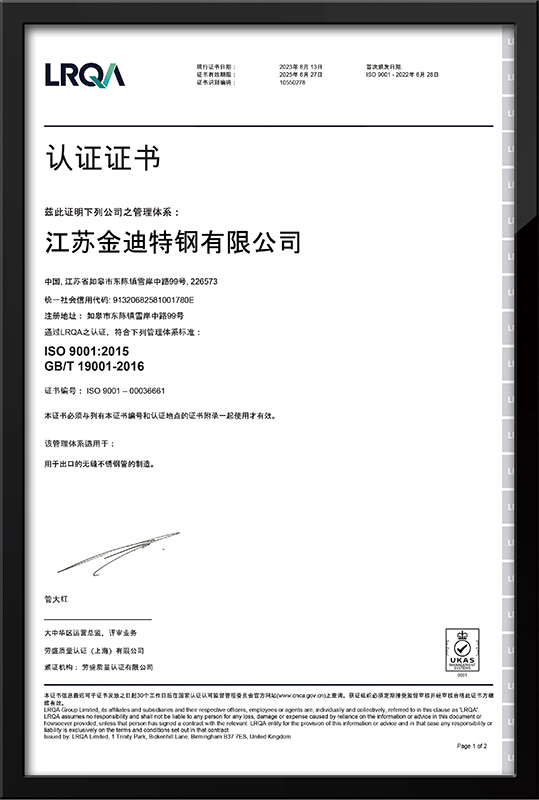
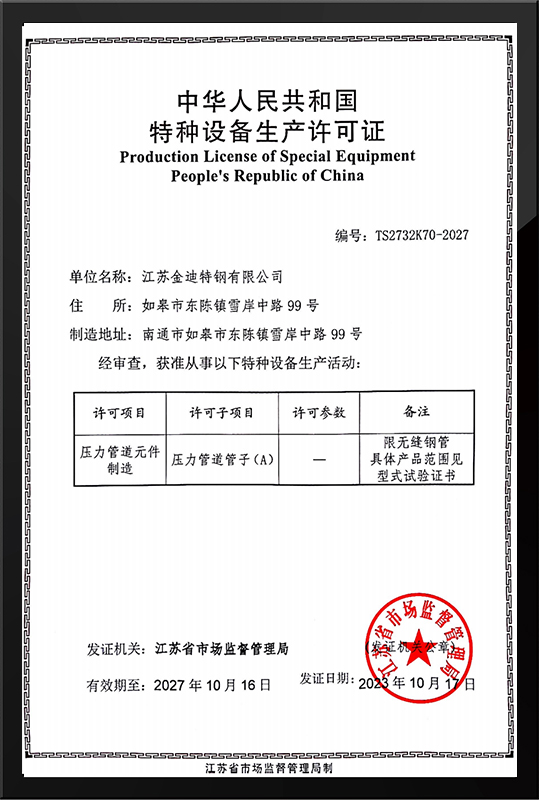
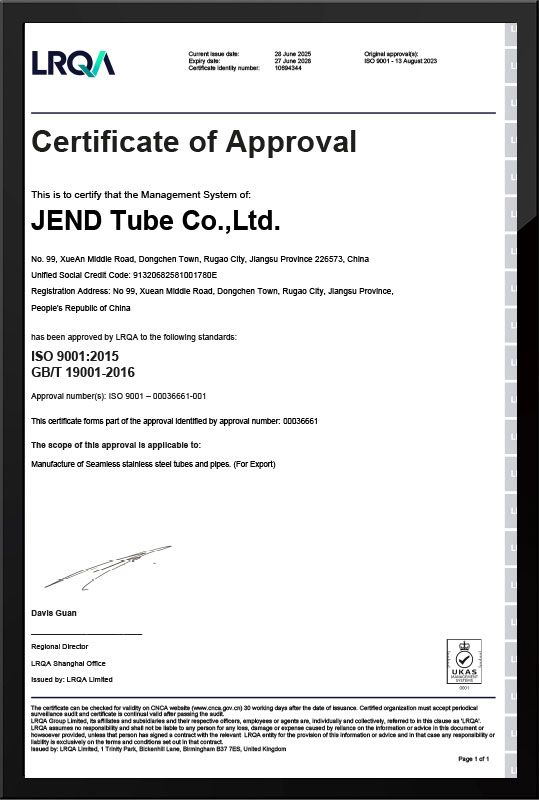
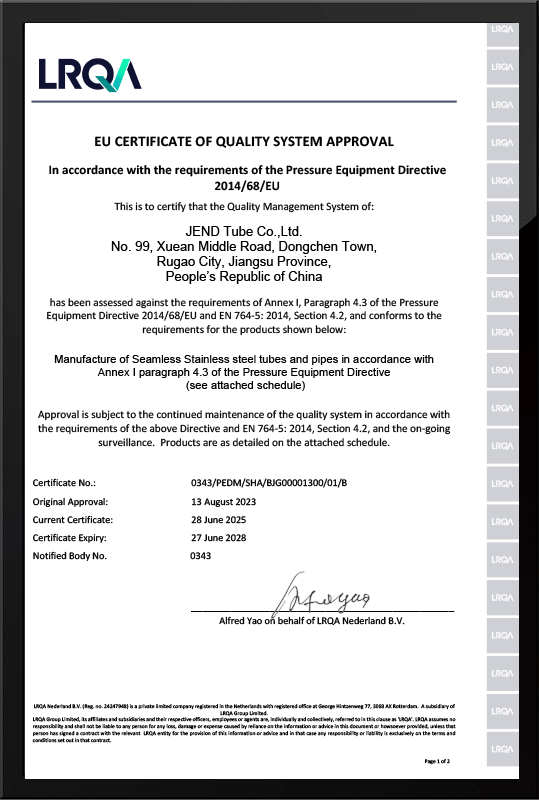
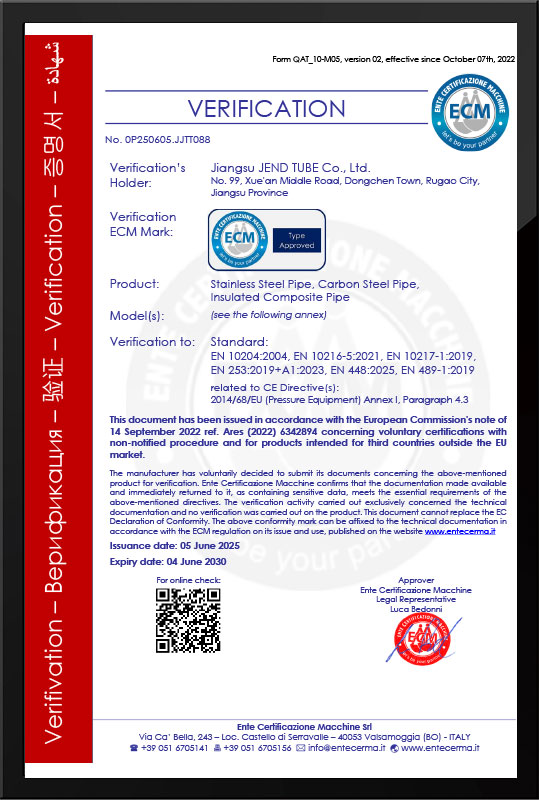
The company has passed ISO9001:2015 quality certification, domestic pressure vessel TS certification, and foreign pressure vessel PED certification. With rich experience and mature technology, we have been expanding our market internationally. At present, our products are exported to more than 50 countries and regions including Europe, America, Southeast Asia, and the Middle East.
The company adheres to different production norms and standards such as the American standard (ASTM), the European standard (EN), the German standard (DIN), the Japanese standard (JIS), the Russian standard (GOST), and the Chinese standard (GB).
Our company specializes in and customizes various specifications of Martensite TP410 (0Cr13, 1Cr13), Ferrite TP405 (1Cr13Al), TP430 (1Cr17), TP444 (0Cr18Mo2), TP439, TP409 (0Cr11Ti), It is also proficient in manufacturing Austenitic seamless stainless steel pipes of series such as TP304(L/H), TP316(L/H/Ti), TP310S, TP317, TP321(H) and TP347(H). Duplex such as S31803, S2205, S32750, S32304, and Nickel-based alloys Monel400, Monel600, Monel800, GH3030, 904L, Inconel 625, etc.
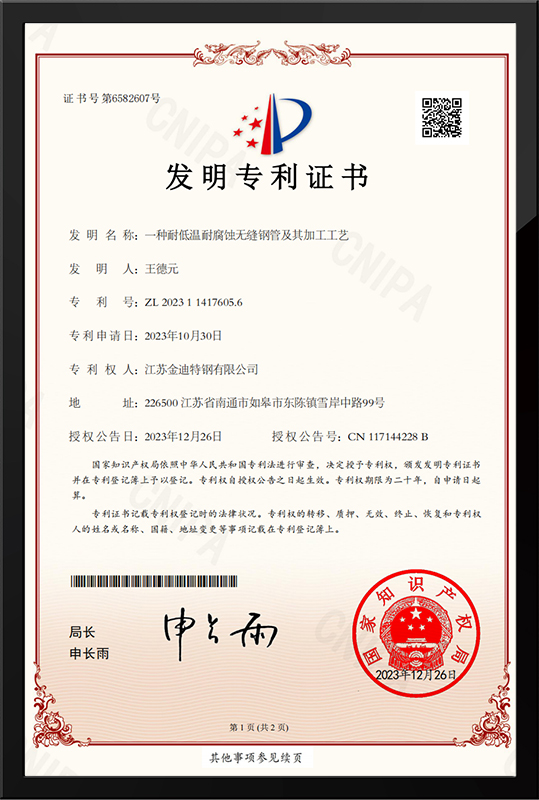
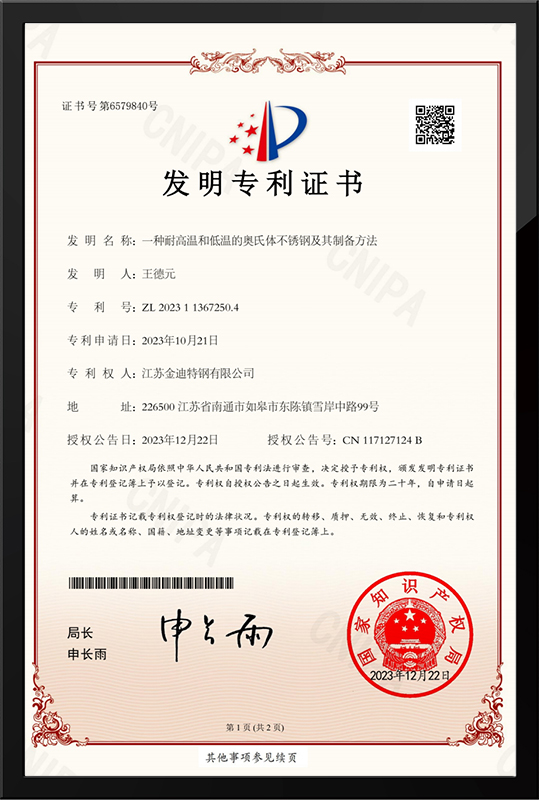
The company mainly produces seamless steel pipes with the following specifications: outer diameter: 3.18mm to 406.4mm, wall thickness: 0.3mm to 20mm, and the longest length is 25000mm. Additionally, it can customize seamless steel pipes with special materials and specifications according to customer requirements. The company attaches great importance to scientific innovation. The staff of the company vigorously develop technological research and development.
Jiangsu Jend Tube Co.,Ltd. will continuously accumulate professional knowledge and capabilities, striving to become a leader in the domestic market and even the world market. Strive to be the most reassuring pipe manufacturing enterprise for customers.
Precision Manufacturing and Process Optimization
We rely on precision equipment and optimized production technologies to achieve outstanding mechanical performance and consistent product quality.

Cold Rolling and Cold Drawing

Solution Heat Treatment
Natural gas solution treatment furnaces and BA solution treatment furnaces optimize the material's grain structure, enhancing corrosion resistance.

Precision Straightening and Polishing
10 straightening machines and 8 finishing polishing machines guarantee product surface smoothness and dimensional accuracy.

Automated Inspection and Quality Assurance
Real-time monitoring systems ensure the stable quality of every batch of products.
Product Usage Tips
Grade Selection by Exhaust Position
Manifold/turbo outlet (750–1000°C): specify austenitic TP321 or cast HK alloy. Front pipe to catalytic converter (600–800°C): specify TP409 Ti-stabilized ferritic. Post-cat center section (400–600°C): specify TP439 or TP441 dual-stabilized. Rear silencer and tailpipe (below 400°C, maximum road salt exposure): specify TP439 or TP444 for maximum corrosion resistance at the most corrosion-critical position in the exhaust system.
Welding Ferritic Exhaust Tube
Weld ferritic exhaust tubes with matching grade filler (ER409 for TP409, ER439 for TP439) using low heat input TIG or MIG process. Ferritic grades are susceptible to grain coarsening in the HAZ at temperatures above 900°C — use stringer beads, minimum interpass temperature, and maximum 2-pass weld procedure to limit HAZ grain growth that reduces toughness at the weld zone. Avoid austenitic filler unless specifically required by dissimilar metal joints.
475°C Embrittlement Avoidance
Ferritic stainless exhaust grades (including TP409, TP439, TP444) experience precipitation of alpha-prime phase at 400–520°C with extended exposure time — manifesting as hardness increase and significant ductility reduction. For exhaust system sections that operate continuously in the 400–520°C range (rear section of some turbocharged diesel applications), verify operating temperature with thermal profiling and consider TP321 austenitic if long-term continuous exposure to this range is confirmed.
Thermal Expansion Management
Ferritic stainless grades have thermal expansion coefficients approximately 25% lower than austenitic grades (11 × 10⁻⁶/°C vs 16 × 10⁻⁶/°C at elevated temperature), which reduces differential expansion stress in joints between ferritic exhaust components and ferritic heat shields or mounting brackets. When connecting ferritic exhaust tubes to austenitic manifolds, the differential expansion must be accommodated by flex couplers or bellows joints sized for the temperature differential and expansion mismatch of the two alloy systems.
Value-Added Processing Services
We provide automotive Tier 1 and Tier 2 supplier processing and qualification support for exhaust tube programs:
Automotive Precision Cutting
Fixed-length cutting to ±0.5mm for automated exhaust bending and assembly line supply without manual measurement.
PPAP Documentation
Full PPAP Level 3 documentation package for automotive supplier qualification including capability studies and control plans.
Grain Size Certification
Forming grain size verification for automotive deep-draw and hydroforming tube qualification per customer engineering specification.
IATF 16949 QMS
Full IATF 16949 quality management system with SPC records for critical dimensions available for automotive audit compliance.
Payment & Shipping
Payment Terms
- T/T (Telegraphic Transfer)
- L/C at Sight (Letter of Credit)
- Western Union
- Flexible terms for long-term partners
Shipping Options
- Sea Freight (FCL/LCL)
- Air Freight for urgent automotive program orders
- Express for sample and prototype quantities
- Automotive-grade steel cradle bundles with corrosion protection wrapping
Certifications & Standards
Our automotive exhaust stainless tubing is manufactured to automotive and international material standards:
ISO 9001:2015
IATF 16949:2016
ASTM A268
EN 10216-5
PPAP Level 3
EN 10204 3.1 MTR
Frequently Asked Questions
What is the difference between TP409 and TP439 for exhaust applications?
TP409 with ~11% Cr and Ti stabilization is the cost-optimized grade for high-temperature front exhaust sections where oxidation resistance governs design. TP439 with ~18% Cr and Ti+Nb dual stabilization provides significantly better corrosion resistance to road salt chloride attack and condensate acid in the rear exhaust sections where corrosion rather than temperature is the life-limiting mechanism. The 7% higher chromium in TP439 delivers dramatically better cold-end corrosion life.
Can austenitic TP304 be used for automotive exhaust instead of ferritic grades?
TP304 is used in aftermarket performance exhaust systems for its polished appearance and adequate temperature resistance. For OEM exhaust production, ferritic grades are strongly preferred because their thermal expansion coefficient is approximately 25% lower than austenitic grades — reducing thermal stress in the exhaust system structure and enabling longer fatigue life in the temperature-cycling exhaust environment. Ferritic grades are also significantly less expensive than austenitic for the large volumes required in OEM automotive production.
What is the maximum temperature for TP409 in exhaust service?
TP409 provides reliable continuous oxidation resistance up to approximately 600°C in air — above this temperature, the Cr₂O₃ scale stability begins to reduce in oxygen-depleted exhaust gas atmospheres. For exhaust positions experiencing temperatures above 600°C (front pipe on high-performance turbocharged engines), specify TP441 with higher chromium content, or TP321 austenitic for temperatures above 750°C where the ferritic grade family's oxidation resistance becomes inadequate for the required service life.
Do you supply PPAP documentation for automotive supplier qualification?
Yes, PPAP Level 3 documentation packages are available for automotive exhaust tube supply, including dimensional capability studies (Cpk ≥ 1.67 target for critical dimensions), material certification to ASTM A268 and IATF 16949, control plan, FMEA, and process flow documentation. Our IATF 16949 quality management system provides the manufacturing quality framework required by automotive OEM and Tier 1 supplier qualification audits.
Is TP444 suitable for marine exhaust applications?
Yes, TP444 with 2% Mo addition and Ti+Nb dual stabilization provides superior corrosion resistance in marine exhaust wet sections where seawater-cooled exhaust creates combined thermal and chloride corrosive attack. Its PREN of approximately 26–28 significantly exceeds TP409 and TP439, providing adequate pitting resistance for the saline condensate environment of seawater-cooled marine exhaust systems at temperatures below the dew point of the exhaust gas-seawater mixture.
What wall thickness is standard for passenger car exhaust tube?
Standard passenger car exhaust tube wall thickness ranges from 1.0mm to 1.5mm for small-bore front pipe sections, and 1.5mm to 2.0mm for larger-diameter center and rear sections. Luxury and high-performance vehicle programs may specify 2.0mm wall for improved acoustic damping and durability. Commercial vehicle and heavy truck exhaust tubes use 2.5mm to 3.5mm walls to accommodate higher exhaust gas temperatures, pressures, and longer design life requirements.
What is the typical lead time for automotive exhaust stainless tubing?
Standard TP409 and TP439 automotive exhaust tube in common OD and wall combinations is available within 20–30 days for production quantities. PPAP first article samples for new program qualification are available within 15 days for standard dimensions. Non-standard dimensions or TP444 marine exhaust grade require 30–45 days. For series production programs, we provide just-in-time delivery scheduling synchronized with customer production planning systems.
Do you supply to automotive OEMs and Tier 1 exhaust system suppliers internationally?
Yes, we supply automotive exhaust stainless tubing to Tier 1 exhaust system manufacturers and Tier 2 component suppliers across Europe, Asia, and the Americas, with IATF 16949 certification, PPAP documentation, and JIT delivery programs managed by our dedicated automotive account team. Global logistics capability supports exhaust program supply to multiple manufacturing locations from a single qualified supplier relationship.
Ready to Order Automotive Exhaust Stainless Steel Tubing?
IATF 16949 certified, full grade portfolio, PPAP ready — your automotive exhaust tube supply partner
Request a Quote